Sunday, February 5, 2012

Introduction: Ideologies and Upheavals


This chapter identifies the aftermath of the Napoleonic Wars. We learned about the spread of the radical ideas. These would include all of our "ism". We have learned about all of the important writer during the romantic period and all of the men and woman who had a huge impact on the society. Ideas emerged and concepts were rejected but they were able to find alternative ideologies. We also learned about the Great Famine and it decreased the Irish population. My blog includes a chapter overview, three important people within this chapter, listening from the past a connection and a summary. I hope that my blog gives you a understanding of the chapter and you are able to determine the important and significant events.
EQ: Who had the greatest impact on this period and why?
I honestly this that Karl Marx shaped this period because he developed ideas and theories that were influential to the people. He was able to separate and eliminate social classes. He continued to be a strong, radical, and spontaneous leader despite peoples views of him.

Three Important People


The Austrian prime minister Klemens Von Metternich(1773-1859) represented the views that were blended by the state which were monarchy, bureaucracy and aristocracy. He hated liberalism he believed that it stirred up the lower class and caused war and bloodshed. He played a huge part in the 1814 Treaty of Paris and was often known as the ladies man. He was also a delegated to the Congress of Vienna. In 1821 he was appointed the chancellor of of Austria and he held this position and name until he pasted away.

"When France has a cold, all of Europe sneezes"
Klemens Von Metternich
Marx color2.jpg 
Karl Marx is the father of communism. He developed The Communist Manifesto (1848) along with Frederich Engle and this was considered a key work of socialism. He played a huge role in devolping social sciences and movements. His thoughts were often derived by his views and phiolphies. Marx commonly acknowloge the difference and seperation between the proletariat and the bourgeoisie.
"The theory of Communism may be summed up in one sentence: Abolish all private property."
Karl Marx
Victor Hugo was the creator of the famous Hunchback of Notre Dame. He was able to exemplify the strange setting and the human emotion evident with in the societies. He was a famous playerwriter and novelist. His writings were often translated traveled across Europe. He also is known for Les Miserable. Both of these are commonly represented as Disney movies and broadways shows today.

"A creditor is worse than a slave-owner; for the master owns only your person, but a creditor owns your dignity, and can command it. "Victor Hugo

Connection Across Continent

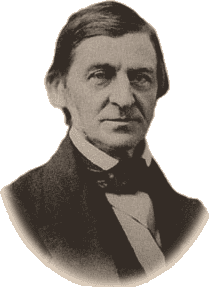
Ralph Emerson
When making connections across continents I would connect Romanticism to Transcendentalist and The Corn Law (1815) to the Nat Turner Slave Law. Romantic literature was first developed in Britain and works were commonly exemplified by poets Wordsworth, Colerdife,Scot Shelly and Keats. Each of the poets seemed to inspire and influence each other. In the United States Transcendentalist was a religious philosophical, literacy movement. They commonly disagreed with each other belief. Ralph Emerson and Henry Thoreau are commonly known for there writings. They believed in nature and you should indentify your purpose within life. Simply the poets would express there views with in there writings.


"A great man is always willing to be little. "
Ralph Waldo Emerson
The Corn Laws was British laws revised in 1815 that prohibited foreign grain unless the price at home rose to improbable levels thus artistocracy but making food prices high for working people. In the United States Nat Tunner Slave Rebellion occurred. Nat Turner beleived that he was called upon by God to lead a slave rebellion. Many innocent slaves were killed  and about 50 whites were killed. They finally made a deal with Turner and his gang. Turner went into hiding and was finally executed on  November 11,1831.

Picturing the Past

The Great Famine and Eviction :
The upper left hand corner imagines identifies the Irish Great Potato Famine. This famine shattered population growth within Ireland. In 1820 they realized that the potatoes were diseased and starvation was a result for lack of food supply. Many people were evicted from there homes, and even left homeless. Most people in Ireland were Irish Catholic and they rented from lazy over priced as well as greedy landlords, who often took advantage of there people.  Millions of people died during this famine. Also many decided to leave Ireland.
Analyzing the Image:
How can this famine relate to other tradjeic epidemic that happened within previous studies? Why do you think the landlords were so cruel and incompassionate?
Connections:
Why do you think this unit is so important? Why do you think the Great Famine is commonly known?

3.2.1


Three things that I have learned:
1. I have learned that radical ideas spread rapidly during this time. Romanticism was mainly based on emotional beliefs and unrestrained imagination and personal life.
2. I also learned that the bourgeoisie was the middle class minority who owned the means of production and according to Marx exploited the working class proletariat's.
3. I also learned that Metternich represented the view that best state of monarchy, and he hated liberalism. He believed that liberalism stirred up the lower class and caused war and blood shed.
Two things that interested me:
1.The Great famine which was the result of four years of potato's crop failure in Ireland, a country that had grown dependent on potatoes as a dietary staple. I think this is remarkable because each time period there was a significant sacrifice and this help unify the people.
2.The Triumph of Democratic Republic is a french illustration that displays the views of the initial revolutionary breakthrough in 1848. This picture shows many different flags and people marching.
One Question:

1.Why was the growth of nationalism so strong?